Why Do We Use Dehydrating Agents in Chemical Processes?
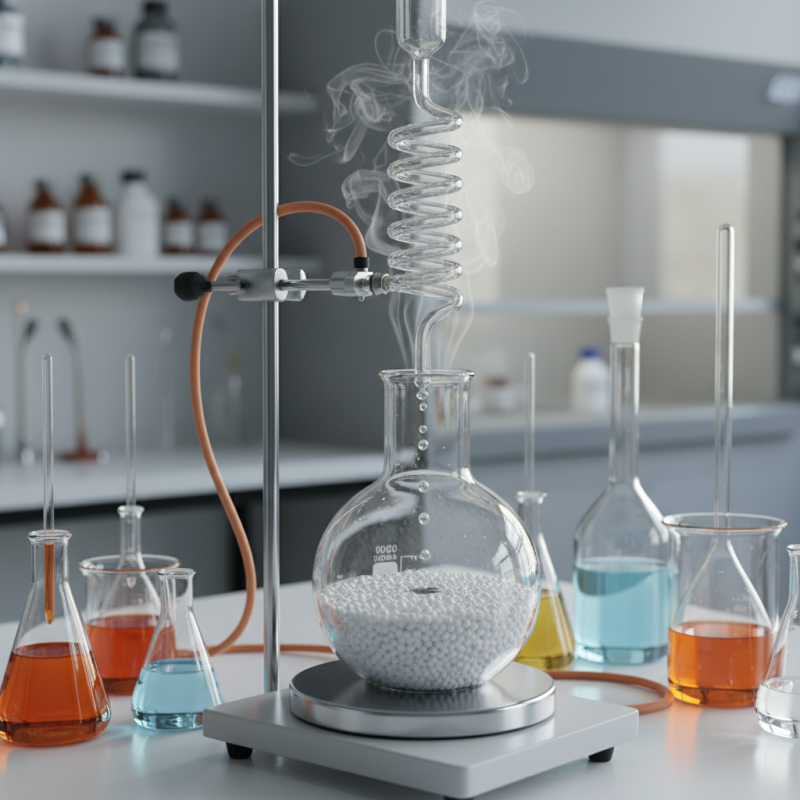
In the realm of chemistry, the use of a dehydrating agent is quite common. These agents play a crucial role in removing water from substances. Their importance cannot be overstated. For instance, when synthesizing compounds, controlling moisture is vital. Excess water can lead to unwanted reactions or byproducts.
Consider the process of esterification. Here, a dehydrating agent helps shift the equilibrium. It drives the reaction forward. Without it, yields may be lower than desired. This can be frustrating for chemists striving for efficiency.
Yet, the choice of a dehydrating agent requires careful thought. Some agents can be hazardous. How do we balance effectiveness with safety? Reflecting on this can enhance our understanding. Ultimately, the role of dehydrating agents is essential, yet complex.
The Role of Dehydrating Agents in Chemical Reactions
Dehydrating agents play a crucial role in various chemical reactions. They help remove water from mixtures, enhancing reaction efficiency. Imagine a reaction where water is an undesired product. In such cases, a dehydrating agent can shift the balance, encouraging the formation of the desired product. An example is using sulfuric acid in esterification processes. It pulls water away, driving the reaction forward.
However, the use of dehydrating agents isn't without its challenges. In some scenarios, these agents can introduce impurities. They might react with other substances, leading to unexpected byproducts. This unanticipated interaction can complicate the desired outcome. For instance, while trying to achieve a specific ester, the residual dehydrating agent might alter the final product's properties.
It's important to reflect on the choice of dehydrating agents. Different agents have varying strengths and interactions. Sometimes, selecting the right one requires trial and error. The goal is to maximize efficiency while minimizing unwanted effects. Learning from each experiment is key to refining the process and achieving the best results.
Why Do We Use Dehydrating Agents in Chemical Processes? - The Role of Dehydrating Agents in Chemical Reactions
| Dehydrating Agent |
Chemical Formula |
Common Applications |
Mechanism of Action |
| Sodium Sulfate (Na2SO4) |
Na2SO4 |
Drying organic solvents |
Absorbs water to form hydrates, thus removing moisture |
| Magnesium Sulfate (MgSO4) |
MgSO4 |
Drying alcohols and ethers |
Forms hydrated salts that trap water molecules |
| Calcium Chloride (CaCl2) |
CaCl2 |
Dehydrating gases and organic compounds |
Pulls water from the surroundings, forming a liquid solution |
| Phosphorus Pentoxide (P2O5) |
P2O5 |
Dehydrating agents in organic synthesis |
Reacts with water to form phosphoric acid, thus eliminating moisture |
| Silica Gel |
SiO2 |
Preservation of pharmaceuticals and food |
Adsorbs moisture on its surface without changing composition |
Types of Dehydrating Agents Used in Industry and Research
Dehydrating agents play a crucial role in various chemical processes. They help remove moisture to stabilize compounds. Several types of dehydrating agents are widely used in industry and research. These agents include phosphorous pentoxide, silica gel, and calcium sulfate. Each agent has unique properties and applications.
Phosphorous pentoxide is highly effective. It can absorb moisture quickly and is often used in labs. Silica gel is another common choice. It is non-toxic and reusable, making it ideal for preserving sensitive materials. Calcium sulfate is less aggressive. It is often used in drying solvents and gases.
However, using these agents requires care. Over-dehydration can lead to the breakdown of sensitive compounds. Not all agents work equally well for every substance. Some may react unexpectedly. It's essential to choose the right dehydrating agent based on the specific chemical involved. This ensures optimal results in any process.
Mechanisms of Action: How Dehydrating Agents Operate
Dehydrating agents play a crucial role in various chemical processes. They help remove water from substances, which often enhances reactions. One key mechanism of action involves the formation of stable complexes with water molecules. These agents typically use strong affinity to bind with water. This binding effectively shifts the equilibrium towards drying.
A report highlights that about 30% of all chemical reactions benefit from water removal. This is particularly evident in organic synthesis, where moisture can hinder product yield. For example, in esterification reactions, using dehydrating agents improves the reaction rate. They facilitate the formation of esters by minimizing the reverse hydrolysis reaction.
Despite their effectiveness, using dehydrating agents can also present challenges. Overuse might lead to undesired side reactions. In some cases, extreme dehydration can alter the nature of the desired product. Monitoring conditions is essential to prevent these issues. It's important to evaluate each reaction's specific needs. Finding the right balance requires careful consideration and sometimes, a learning curve.
Applications of Dehydrating Agents in Synthesis and Purification
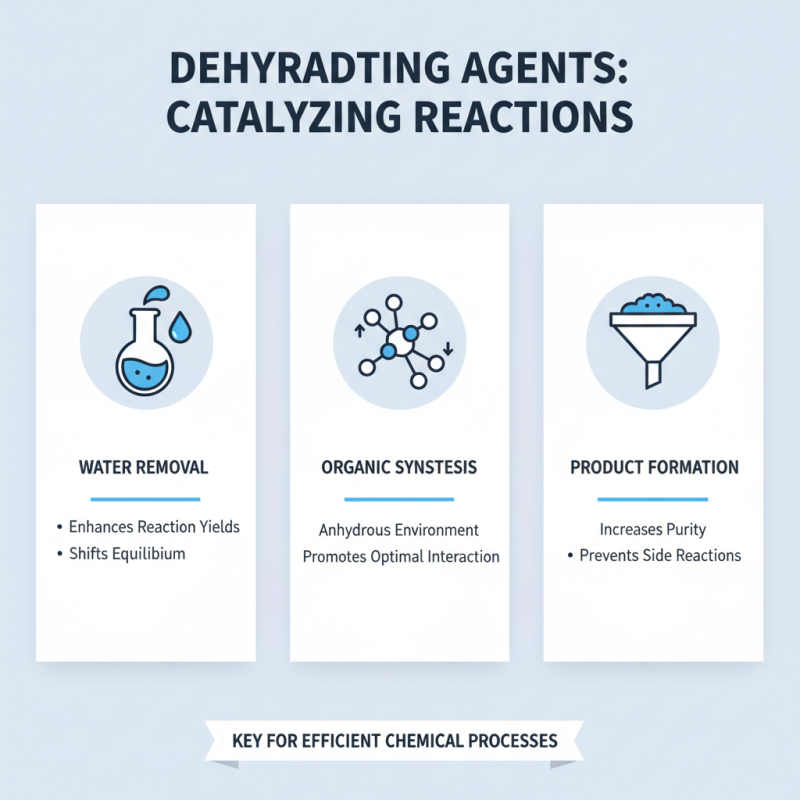
Dehydrating agents play a crucial role in various chemical processes. They are essential for removing water from substances, allowing for better yields in reactions. In organic synthesis, these agents create anhydrous environments that promote optimal chemical interaction. For instance, removing water can shift equilibrium positions, enhancing the formation of desired products.
In purification processes, dehydrating agents help to isolate compounds. During extraction, they can eliminate moisture from solvent mixtures. This step often leads to the precipitation of target substances, increasing purity. Yet, the effectiveness of a dehydrating agent can vary. Some agents may not fully eliminate all water, which can lead to incomplete reactions or lower yields. It is essential to choose the right agent for the task.
The use of dehydrating agents may also pose challenges. Over-dehydration can damage sensitive compounds, changing their structures. It’s vital to closely monitor conditions to avoid such issues. Researchers often revisit their methods to improve outcomes. Adjustments in concentration and duration are common to refine results. Balancing efficiency and integrity is key in any chemical process involving dehydration.
Impact of Dehydrating Agents on Reaction Efficiency and Yield
Dehydrating agents play a crucial role in enhancing reaction efficiency and yield in chemical processes. By removing water from reactants, these agents facilitate reactions that require dry conditions. For instance, the presence of water can significantly hinder various chemical reactions, reducing overall yield.
According to recent industry reports, reactions involving dehydrating agents can increase product yield by up to 30%.
One significant advantage of dehydrating agents is their ability to promote equilibrium shifts. In dehydration reactions, removing water shifts the equilibrium toward the formation of desired products. This shift is critical in synthesizing various compounds, particularly in organic chemistry. However, improper use can lead to incomplete reactions or side product formation, resulting in lower yield. In fact, a study showed that over 15% of reactions failed due to inadequate dehydration methods.
Tips for effective use of dehydrating agents include:
- Selecting the right agent for specific reactions
- Carefully controlling reaction conditions
- Monitoring temperature and concentration
- Ensuring that the selected dehydration method is suitable for your specific materials
- Keeping a detailed log of experiments to identify patterns for improvement